The Cisco Spaces Experience Center is not available for mobile devices as it is best experienced in desktop view. Please access it using a laptop display or higher.
Employee Experience
Employees start the day with everything they need
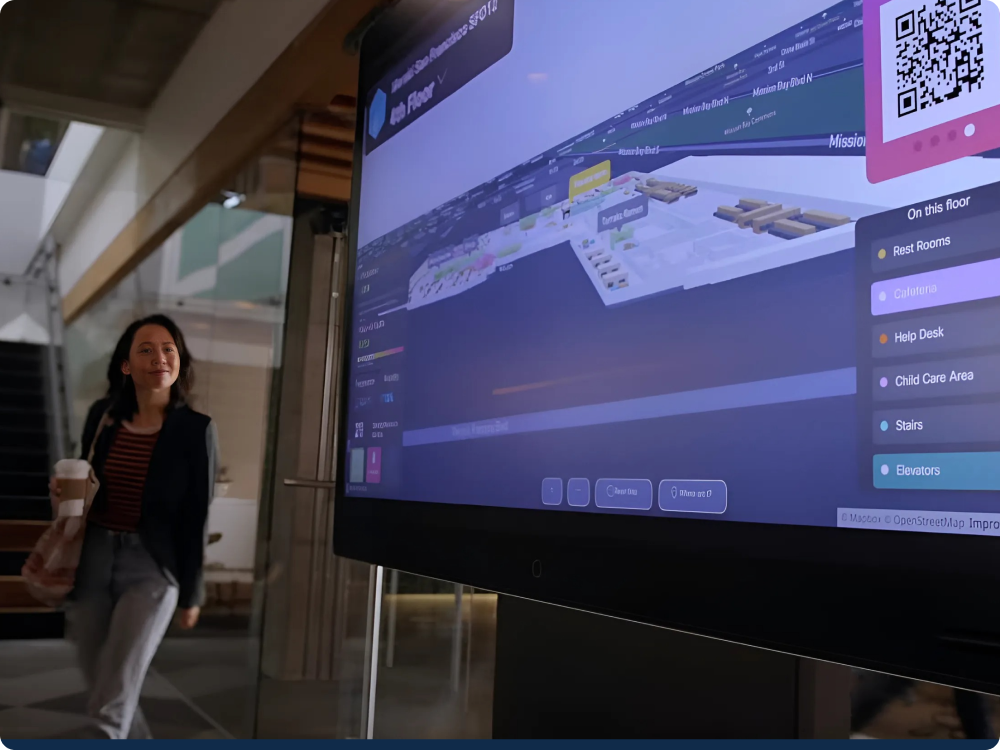
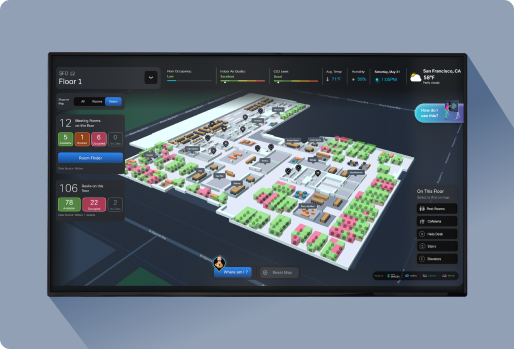
An employee pushes through the office doors and is automatically connected to Wi-Fi. A quick glance at the digital signage tells them everything. The third floor is buzzing. Air quality is perfect. Two meeting rooms free. Five empty desks – all on a 3D map.
Within seconds, they know everything they need. And your organization continues to be the best place to work because employee experience matters.
1 / 6
Spaces Apps
Space Explorer
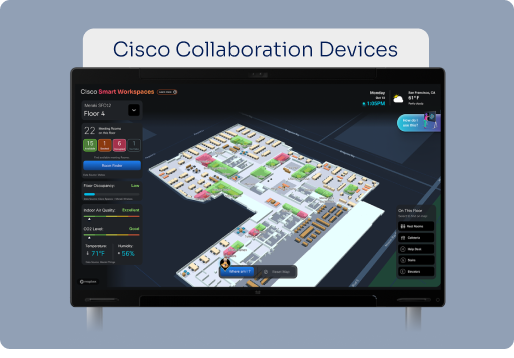
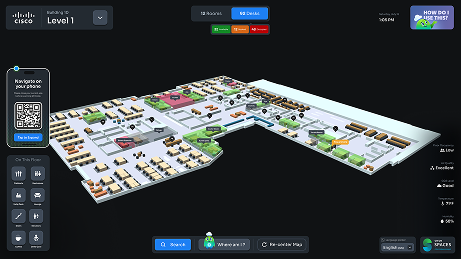
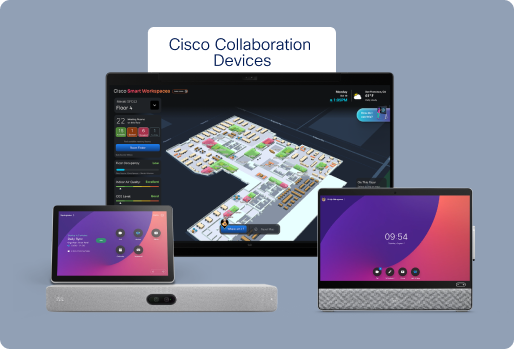
Onboard, configure and manage digital signage (Webex interactive signage as well as non-interactive displays and TVs) across the workplace. Display information such as occupancy, indoor air quality, temperature, availability of meeting rooms, desks and amenities, on 3D floor plans.
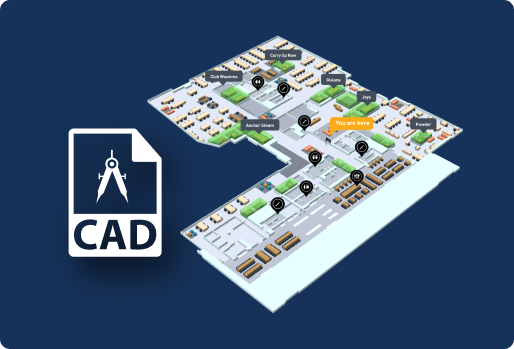
Spaces indoor maps provide spatial awareness, helping visitors orient themselves and effortlessly navigate the building. Spaces’ AI-powered mapping engine takes facilities CAD maps, deconstructs layers and converts them into software defined 3D maps, that become a canvas for hybrid work experiences - on signage, desktops and mobile phones.
Leverage the Cisco Webex Board Series interactive signage to display Cisco Spaces 3D maps and overlay occupancy, air quality information and also provide an interactive view of workspace availability.
Non Interactive Signage
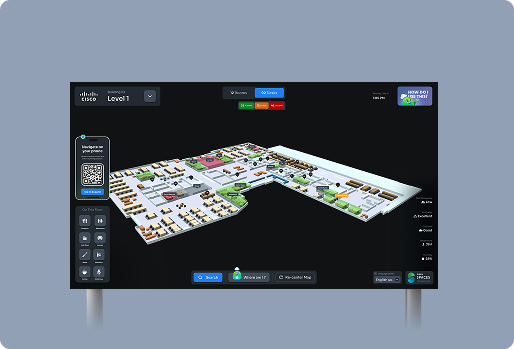
Use Cisco Spaces on non-interactive digital signage or static display configurations to display 3D maps and overlay occupancy, air quality information and more.
For Occupancy Data
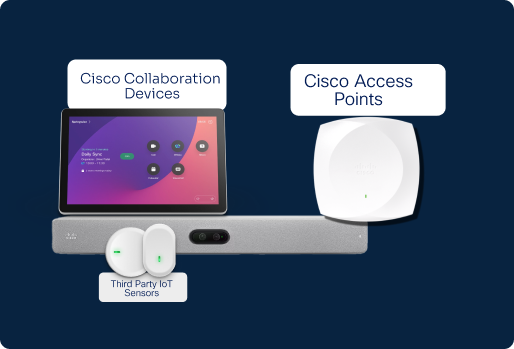
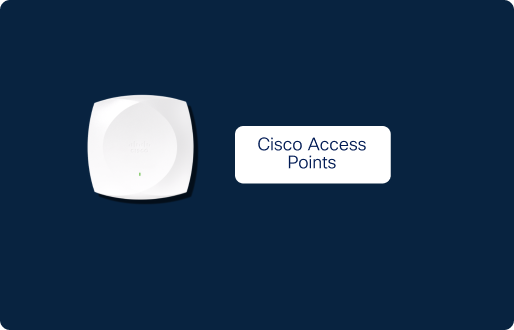
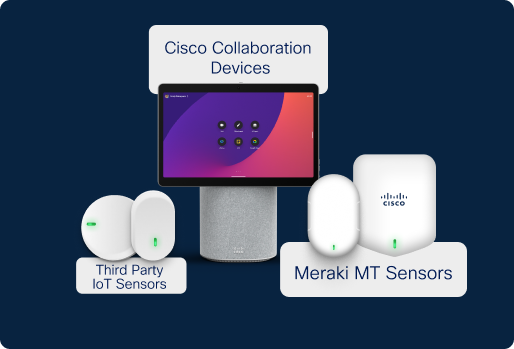
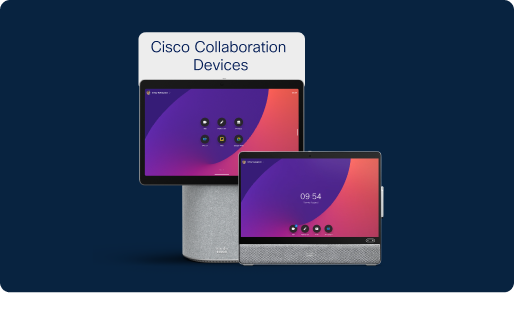
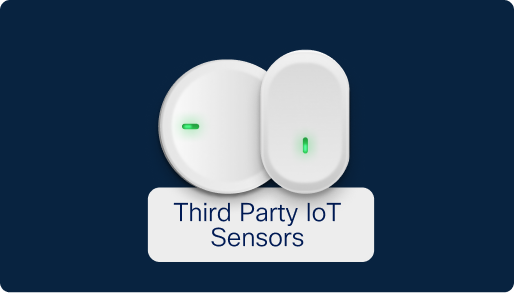
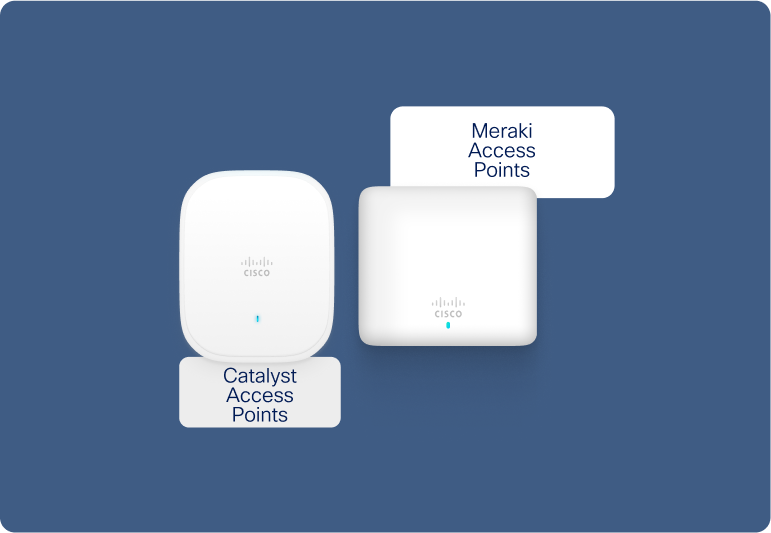
With Cisco Spaces, your wireless network (Catalyst or Meraki) becomes a sensor for occupancy, providing valuable insights into building, floor and neighborhood-level occupancy data. For room occupancy information, Cisco Spaces leverages Cisco Collaboration Devices (Board, Room and Desk Series) and/ or third party occupancy sensors from the Cisco Spaces IoT Device Marketplace and use your Catalyst 9000 Access Points as a gateway.
For Environmental Data
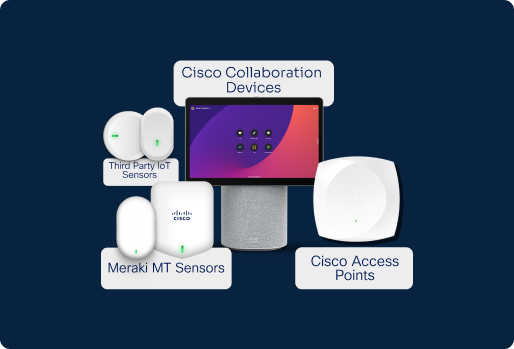
Cisco Collaboration Devices have environmental sensors embedded in them and measure the air quality, temperature, humidity and noise levels. The Meraki MT sensor family intelligently monitors temperature, humidity, indoor air quality and co2 levels. You can also choose third-party IoT environmental sensors from the Cisco Spaces IoT Device marketplace and use your Catalyst 9000 Access Points as a gateway.
96% of employees say they need intelligent workplace technology to improve their work environment (Cisco Intelligent Workplace Study). Organizations that deliver intuitive, feature-rich tools see higher employee satisfaction, better retention, and increased productivity. Cisco Spaces provides the foundation – leveraging Cisco's network infrastructure and collaboration devices to create workplaces where employees thrive.
Employee Productivity
Find the right meeting room in seconds
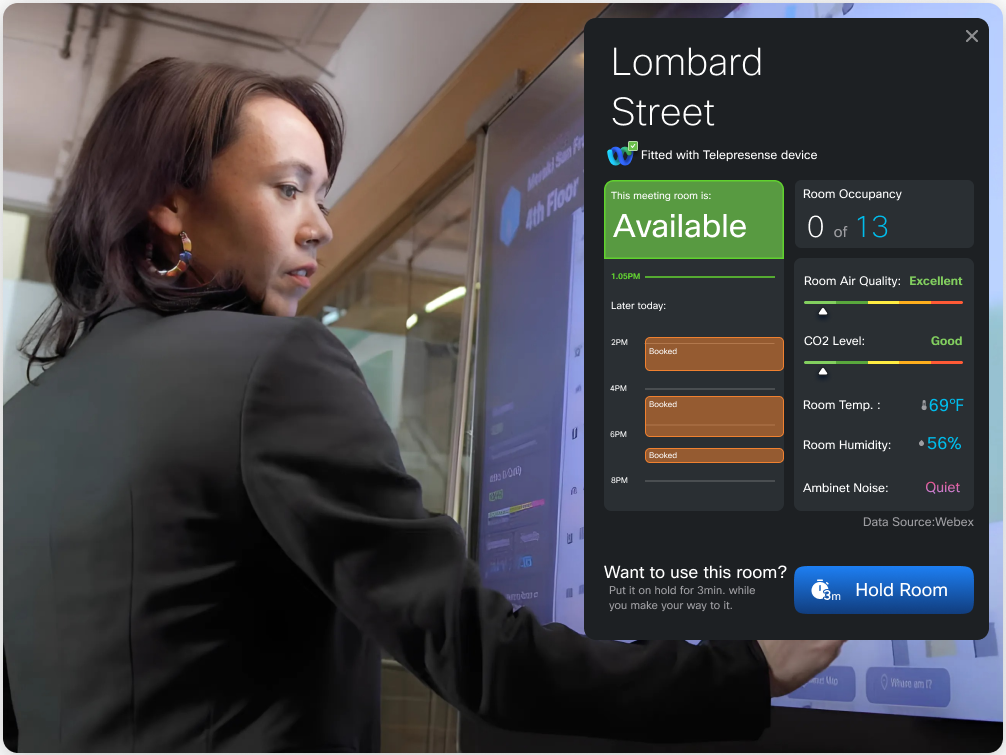
Later in the day, when an ad hoc meeting comes up, employees can use Kiosk to filter rooms by team size, capacity, equipment, indoor air quality, and noise levels. The 3D map highlights the best-fit options, allows the room to be placed on temporary hold, and shows the quickest path to get there.
2 / 6
Spaces Apps
Space Explorer
Onboard, configure and manage digital signage (Webex interactive signage as well as non-interactive displays and TVs) across the workplace. Display information such as occupancy, indoor air quality, temperature, availability of meeting rooms, desks and amenities, on 3D floor plans.
Leverage the Cisco Webex Board Series interactive signage to display Cisco Spaces 3D maps and overlay occupancy, air quality information and also provide an interactive view of workspace availability.
Use Cisco Spaces on non-interactive digital signage or static display configurations to display 3D maps and overlay occupancy, air quality information and more.
For occupancy data
With Cisco Spaces, your wireless network (Catalyst or Meraki) becomes a sensor for occupancy, providing valuable insights into building, floor and neighborhood-level occupancy data. For room occupancy information, Cisco Spaces leverages Webex Devices (Board Series, Room Series and Kits, Desk Series) and/or third-party occupancy sensors from the Cisco Spaces IoT Device Marketplace.
For environmental Data
Cisco Catalyst 9136 Series access points have built-in environmental sensors that measure air quality (Total Volatile Organic Compounds [TVOC]), temperature and humidity. Select Webex devices come with environmental sensors embedded and measure air quality, temperature, humidity and noise levels. The Meraki MT sensor family intelligently monitors temperature, humidity, indoor air quality and co2 levels. You can also choose third-party IoT environment sensors from the Cisco Spaces device marketplace.
96% of employees say they need intelligent workplace technology to improve their work environment (Cisco Intelligent Workplace Study). Organizations that deliver intuitive, feature-rich tools see higher employee satisfaction, better retention, and increased productivity. Cisco Spaces provides the foundation – leveraging Cisco's network infrastructure and collaboration devices to create workplaces where employees thrive.
Indoor Navigation
Easily navigate the office
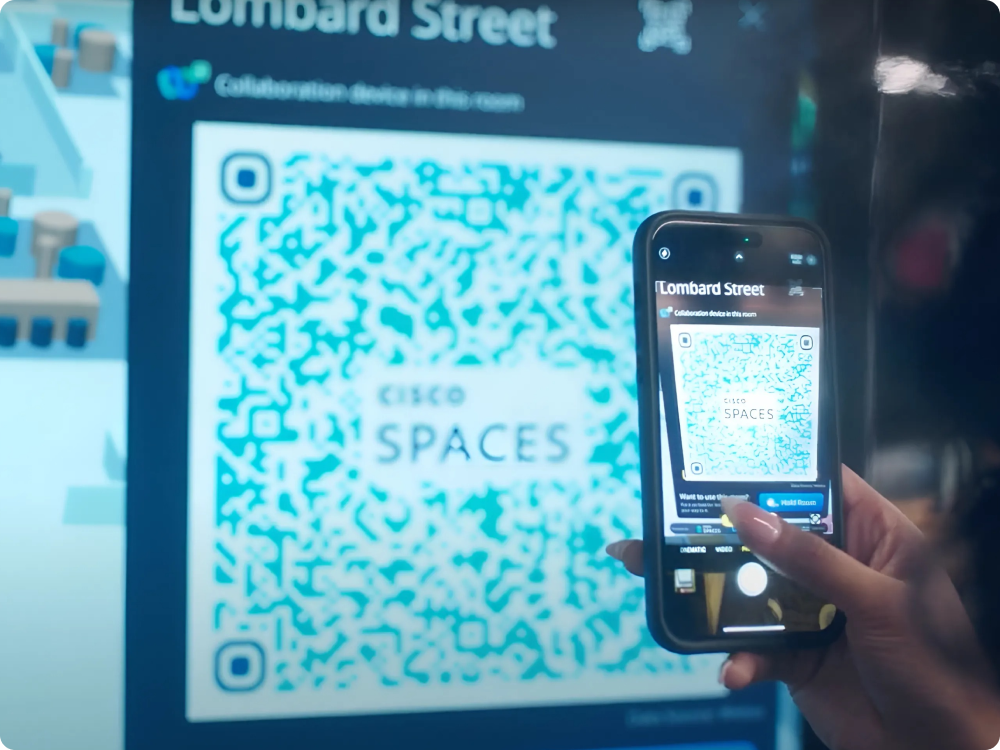
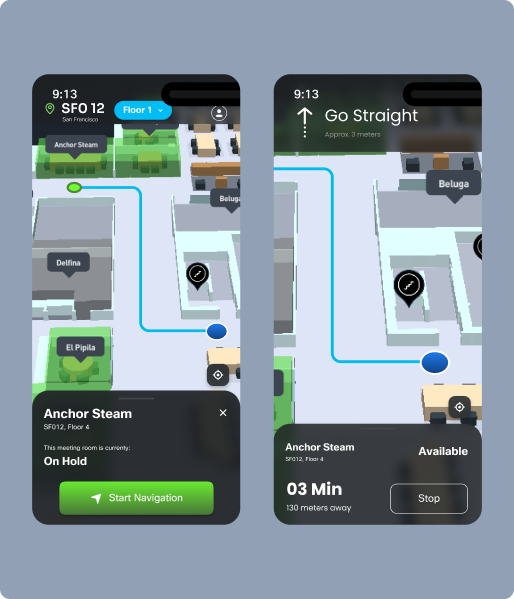
With the meeting room on hold, employees scan the QR code to get turn-by-turn directions on their phone instantly. No app download required. They arrive on time, keeping meetings efficient and the workday on track.
3 / 6
Spaces Apps
Indoor Navigation
Indoor navigation is delivered via a web app or an App Clip (iOS) - a light weight version of the app that provides users dynamic navigation, without the need to download a full mobile application.
Cisco Wireless Access Points [Catalyst 9100 series with WLC 9800 and at-least 17.9.5 software recommended and/or Meraki Wi-Fi 6 & 6E access points] are used as beacons to enable wayfinding. For all other AP models, BLE beacons are required and can be purchased from the Cisco Spaces third-party IoT Device Marketplace.
Indoor navigation helps employees save up to 12 minutes per meeting by reducing time spent searching for rooms and amenities – resulting in $1,215K in productivity gains.
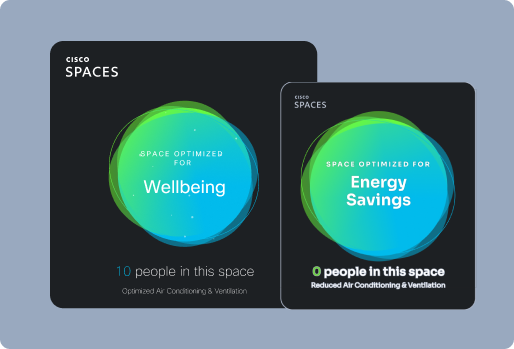
As employees enter the meeting room, ventilation automatically adjusts based on occupancy to maintain optimal indoor air quality, creating a healthier, more productive environment. When the room is empty, ventilation and air conditioning shift to standby to reduce energy use, helping sustainability teams lower energy costs without compromising comfort.
4 / 6
Spaces Apps
Smart Rooms
Leverage real-time occupancy and air quality information to proactively and automatically adjust ventilation by controlling the air vents in the room. This creates an optimal meeting environment that boosts wellbeing and productivity. In addition, optimizing air conditioning saves energy and reduces the building's carbon footprint.
Cisco Spaces leverages Webex devices (Board Series, Room Series and Kits, Desk Series) and/or third-party occupancy sensors from the Cisco Spaces IoT Device Marketplace, to sense occupancy in a meeting room.
For Room environmental Data
Select Cisco Collaboration Devices are embedded with environmental sensors to measure indoor air quality, temperature, humidity and noise levels. The Meraki MT sensor family intelligently monitors indoor environments, providing data into temperature, humidity, indoor air quality and co2 levels.
Business Impact
Exposure to high CO₂ levels can reduce cognitive and decision-making performance by 50% or more (Harvard T.H. Chan School of Public Health). Indoor air quality directly impacts focus, response time, and overall productivity. Cisco Spaces uses real-time occupancy and air quality data to automatically adjust ventilation, helping create healthier workspaces for employees while enabling sustainability teams to optimize energy use more efficiently.
Smart Desking
Find & book a desk with ease
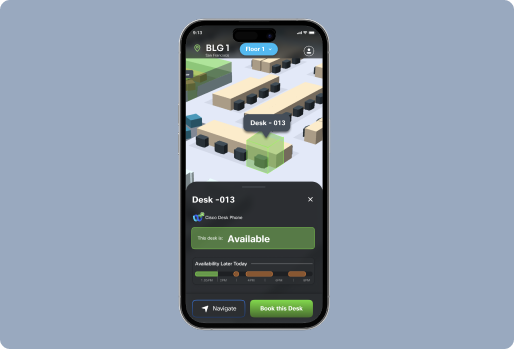
Employees reserve available desks from anywhere using the Space Explorer web app, navigate to the desk with indoor navigation, and confirm the reservation with a quick check-in on arrival. They can share their desk location with colleagues to coordinate in-person collaboration. When finished, a simple check-out frees the desk for others and keeps occupancy data accurate – helping teams make better use of space.
5 / 6
Spaces Apps
Space Explorer Web App
Book a desk before you arrive, from anywhere, using the Spaces web app on your mobile phone. Your desk will be reserved and ready when you arrive at the office, for the hours you need it.
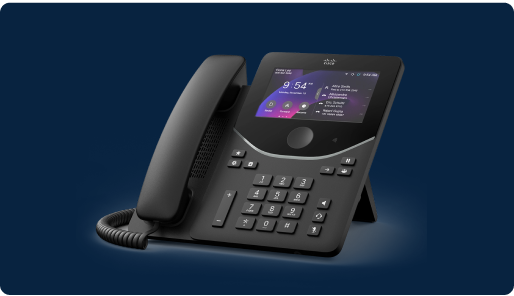
Cisco Desk Phones and Cisco Spaces are removing the stress of employees hunting for available desks in the area they want to be seated in. They also provide a personalized space and collaboration capabilities in one device. IT Teams don’t need to buy and piece together multiple devices to do this.
Cisco Desk Series and Cisco Spaces are removing the stress of employees hunting for available desks in the area they want to be seated in. They also provide a personalized space and collaboration capabilities in one device. IT Teams don’t need to buy and piece together multiple devices to do this.
With nearly half of employees working remotely and over 80% of organizations adopting hybrid work, assigned desks often sit unused. Desk booking helps employees plan office days with confidence while enabling more efficient use of workspaces.
Real estate teams identify consolidation opportunities & drive savings
Teams can review occupancy across their portfolio using real-time and historical insights to understand how buildings, floors, and zones are used. Utilization gaps become clear, consolidation opportunities emerge, and decisions once based on costly manual studies can now be made continuously with better data. Occupancy intelligence can also power AI-driven workflows that optimize utilization, recommend space allocation changes, and improve portfolio planning.
1 / 4
Spaces Apps
Space Utilization
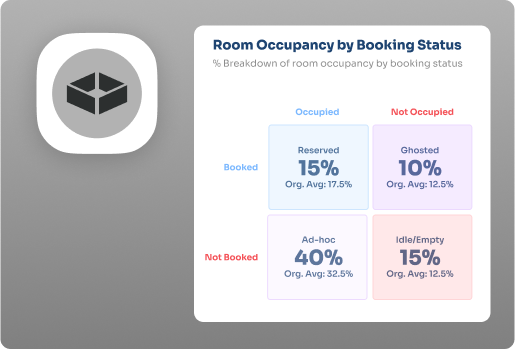
Get insights into utilization of buildings, floors, rooms and desks. With historical an real-time occupancy data, you can reconfigure underutilized meeting rooms, reduce ghost meetings, adjust layouts to better meet the needs of your employees and optimize energy usage based on occupancy.
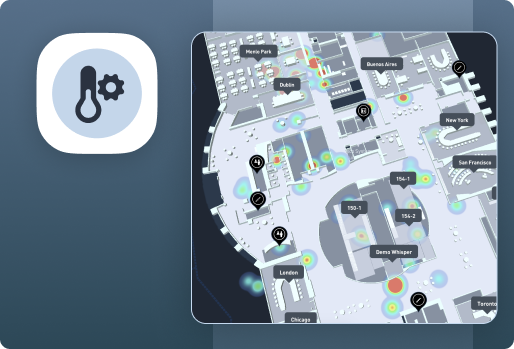
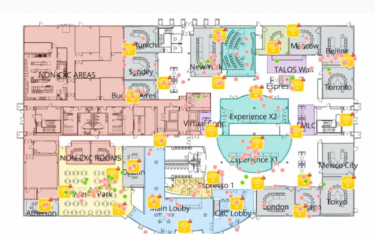
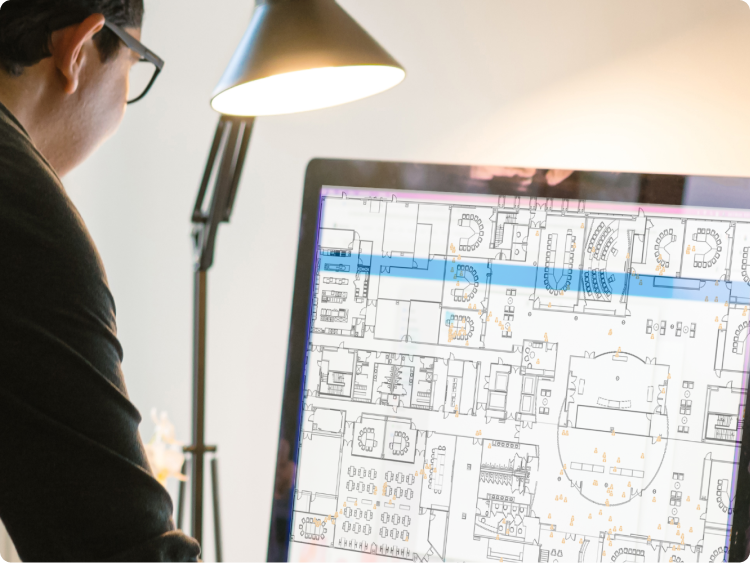
See where people are located and how they use your workspace, on a 3D map of the floor. Watch floor occupancy heat maps change in real-time or play them back over the past 24 hours to discover spaces with the most and least foot traffic.
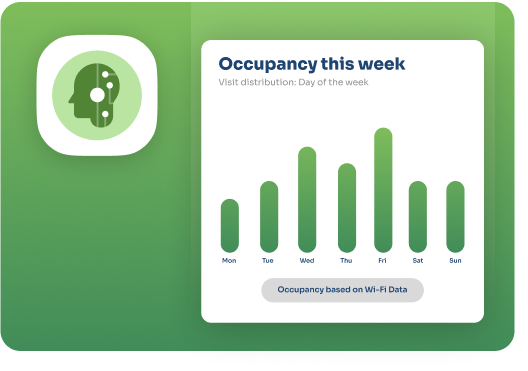
Analyze occupancy trends and patterns, understand how busy your buildings typically are at various times of the day and days of the week. Benchmark performance and see how your buildings stack up against each other, as well as against the industry average.
Leverage Webex Board Series interactive signage and non-interactive displays, smart TVs, etc, to power the smart workspaces digital signage experience.
With Cisco Spaces, your wireless network (Catalyst or Meraki) becomes a sensor for occupancy, providing valuable insights into building, floor and neighborhood-level occupancy data. For room occupancy information, Cisco Spaces leverages Webex devices (Board Series, Room Series and Kits, Desk Series) and/or third-party occupancy sensors from the Cisco Spaces IoT Device Marketplace.
Real estate teams save approximately $800,000 per building over five years by eliminating expensive manual occupancy studies which cost $40,000 per building, four times annually.
The real value goes deeper. Continuous insights into how spaces are actually used across buildings, rooms, and zones enable smarter decisions. Space consolidation opportunities surface. Lease renewals become data-driven. Real estate overheads shrink. Strategic planning replaces reactive management.
HVAC runs on a fixed schedule – 8am to 6pm, regardless of actual occupancy leading to wasted energy and unnecessary emissions. But with Cisco Spaces, the team sees real occupancy patterns. For instance: third floor empties by 3pm on most days and meeting rooms sit unused after 5pm. The team now adjusts HVAC to match these actual occupancy trends. Energy consumption drops and carbon footprint shrinks.
2 / 4
Spaces Apps
Spaces API
Integrate the Spaces API with enterprise applications and AI workflows. Trigger automated actions based on user behavior, location, and real-time events.
Live Occupancy
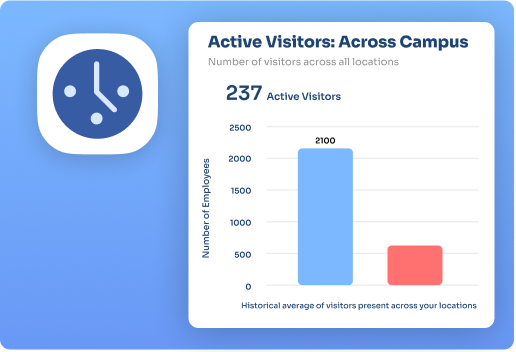
Visualize the number of employees inside buildings in real-time. Define capacity thresholds and receive alerts when the criteria is met. Get notified via a Webex Teams, SMS, Email or trigger a workflow via API.
Leverage Webex Board Series interactive signage and non-interactive displays, smart TVs, etc, to power the smart workspaces digital signage experience.
With Cisco Spaces, your wireless network (Catalyst or Meraki) becomes a sensor for occupancy, providing valuable insights into building, floor and neighborhood-level occupancy data. For room occupancy information, Cisco Spaces leverages Webex devices (Board Series, Room Series and Kits, Desk Series) and/or third-party occupancy sensors from the Cisco Spaces IoT Device Marketplace.
For environmental Data
Cisco Catalyst 9136 Series access points have built-in environmental sensors that measure air quality (Total Volatile Organic Compounds [TVOC]), temperature and humidity. Select Webex devices come with environmental sensors embedded and measure air quality, temperature, humidity and noise levels. The Meraki MT sensor family intelligently monitors temperature, humidity, indoor air quality and co2 levels. You can also choose third-party IoT environment sensors from the Cisco Spaces device marketplace.
Every meeting room where HVAC is optimized based on occupancy saves up to 100 lbs of carbon emissions annually. Smart rooms deliver 31% lower CO2 levels compared to rooms without this technology. Scale this across your portfolio. Dozens of meeting rooms, multiple buildings. The impact is significant.
Environmental Monitoring
Ensure optimal air quality for employee well-being
The facilities team uses Cisco Spaces to monitor the indoor environment and receive alerts if any anomalies are detected in metrics like air quality, temperature, humidity, CO2 levels, etc. Using this information, they can make necessary adjustments to ensure the wellbeing and productivity of occupants.
3 / 4
Spaces Apps
Environmental Analytics
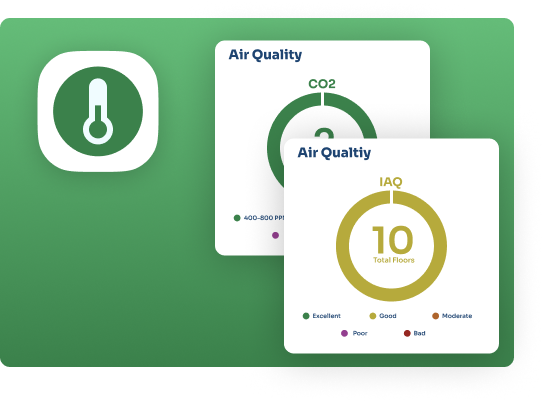
Measure and evaluate critical environmental metrics such as carbon dioxide levels, TVOC (Total Volatile Organic Compounds), ambient noise, temperature and humidity. Leverage this data to take necessary corrective action to ensure optimal indoor conditions and enhance the overall environmental quality within your facilities.
Select Cisco Collaboration Devices come with environmental sensors embedded and measure air quality, temperature, humidity and noise levels. The Meraki MT sensor family intelligently monitors temperature, humidity, indoor air quality and co2 levels.
You can also choose third-party IoT environment sensors from the Cisco Spaces device marketplace.
Exposure to high levels of CO2 can reduce cognitive and decision-making performance by 50% or more. [Harvard T.H. Chan School of Public Health]
The air quality within an office can significantly impact an employee’s cognitive function, including response times and ability to focus, and it may also affect their productivity. Cisco Spaces senses real-time room occupancy and indoor air quality levels to proactively and automatically adjust ventilation and create healthier, productive spaces.
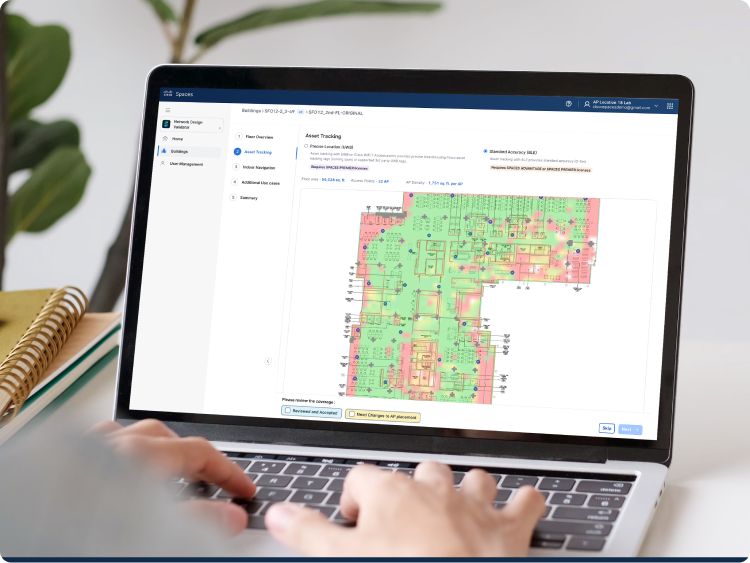
Networks designed for connectivity are optimized for coverage, throughput, and capacity. But smart space use cases such as Indoor Navigation, Asset Tracking, Occupancy Analytics, Wi-Fi Onboarding and more – require higher precision, different access point density, and more strategic placement. Without this, outcomes fall short and experiences degrade.
Validate your network designs to support both connectivity and smart space use cases from the start to avoid costly redesigns and ensure you are outcome-ready from day one.
1 / 6
Spaces Apps
Smart Spaces Studio
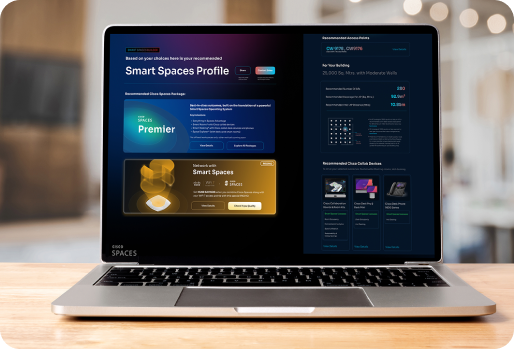
A pre-sales tool to plan, deploy and optimize your network for smart spaces use cases.
With Smart Spaces Studio, simply choose the outcomes you want to achieve, and the tool shows you a pre-sales estimate (+/- 5-10%) of the hardware and software packages needed for outcomes selected.
Validate your network designs for smart spaces use cases
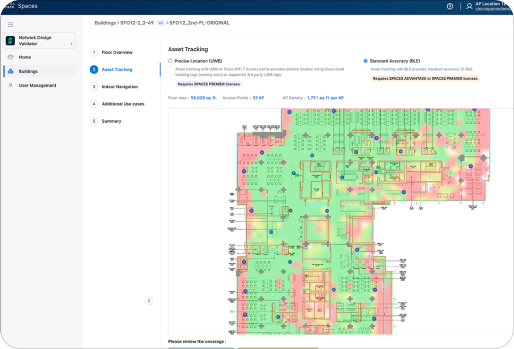
The Smart Spaces Validator (currently in Beta) helps IT teams and partners validate network designs for smart space use cases like indoor navigation, BLE/UWB asset tracking, and occupancy analytics. It simplifies use case deployment and ensures infrastructure is scalable, and future-ready as new use cases come up.
Cisco’s approach reduces costly post-deployment rework by getting network design right the first time – minimizing costly redesigns, hardware additions, and support escalations. It also accelerates time-to-value for smart space initiatives by ensuring use cases perform as expected from day one, delivering a more consistent end-user experience and stronger alignment between IT investments and business outcomes.
Track & Locate IT Assets
Quickly find IT assets
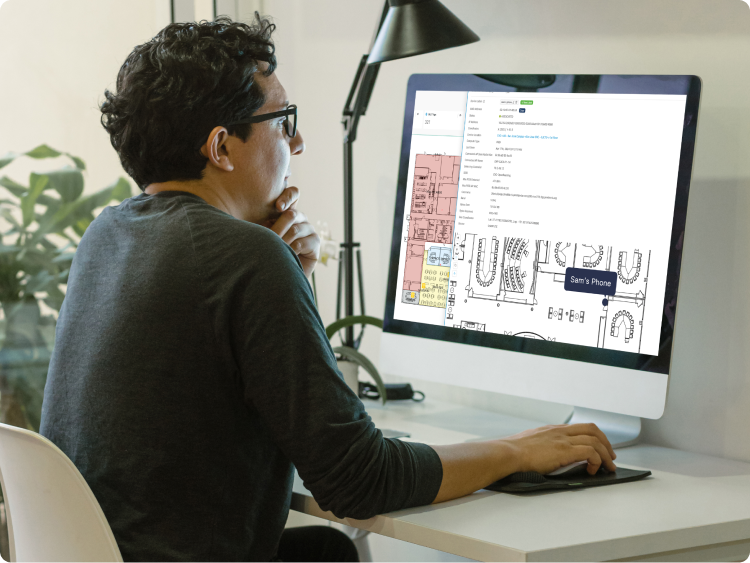
Quickly locate organization-owned devices such as phones, laptops, and tablets that may be misplaced, lost, or moved. IT teams can view device locations in a single place and search the device label in the Detect & Locate app to identify the last known location for faster retrieval.
2 / 6
Spaces Apps
Detect & Locate
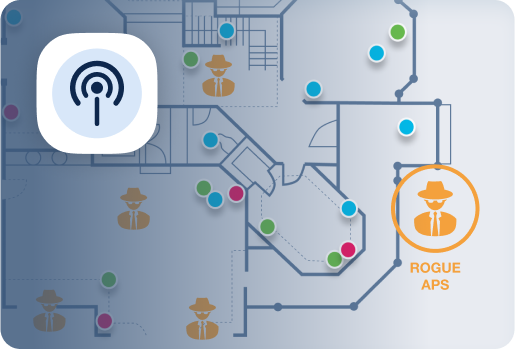
Find devices easily and prevent loss of your connected Wi-Fi devices, by tracking their location in real-time. The most common type of devices are Wi-Fi clients, but the app can also detect the location of Wi-Fi RFID tags, rogue APs, rogue clients and BLE tags.
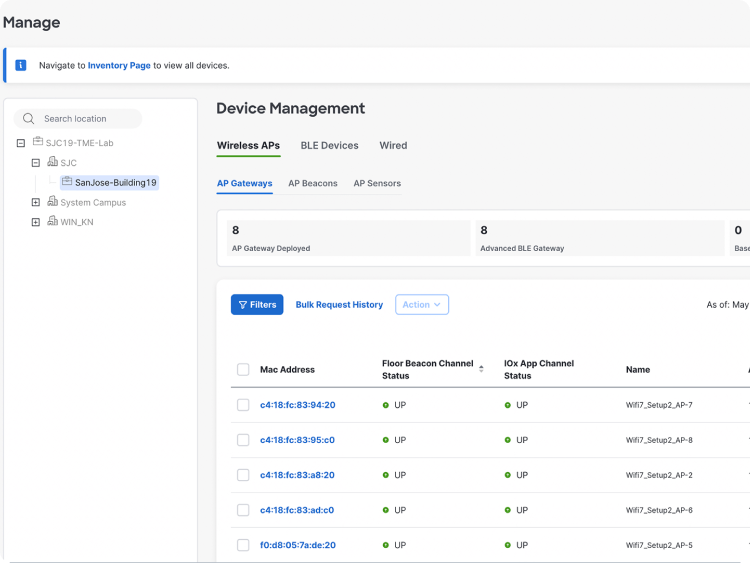
Detect & Locate requires that you place Access Points on maps via Cisco Prime and then export the maps to Cisco Spaces.
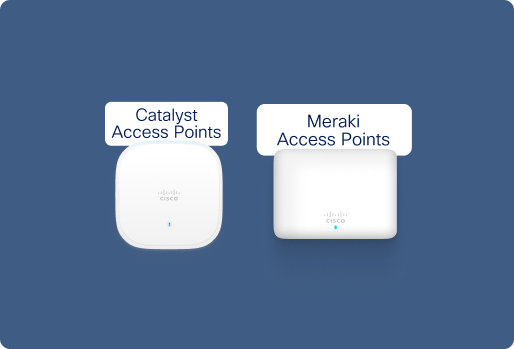
Cisco Wireless Access Points
Wireless network (Catalyst or Meraki) or Cisco Meraki MV cameras.
Business Impact
Reduces time spent searching for devices, helps avoid unnecessary replacements, redundant purchases and improves visibility into IT inventory across locations.
Detect Rogue Devices
Detect rogue devices on the network
With Cisco Spaces, IT has visibility into all of the rogue Access Points. It allows them to investigate and determine the location of rogue APs and clients, as classified by wireless LAN controllers. This proactive approach helps in enhancing overall network security and preventing unauthorized access.
3 / 6
Spaces Apps
Detect & Locate
Find devices easily and prevent loss of your connected Wi-Fi devices, by tracking their location in real-time. The most common type of devices are Wi-Fi clients, but the app can also detect the location of Wi-Fi RFID tags, rogue APs, rogue clients and BLE tags.
OpenRoaming provides mobile users with frictionless Wi-Fi onboarding by linking together access providers (such as public venues, retailers, airports and large enterprises) and identity providers (such as service provider carriers, devices). Users sign on only once and are automatically connected to OpenRoaming networks wherever available.
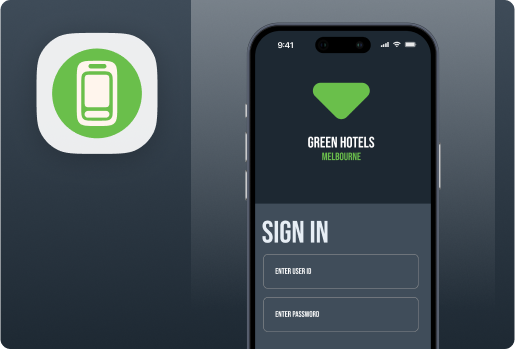
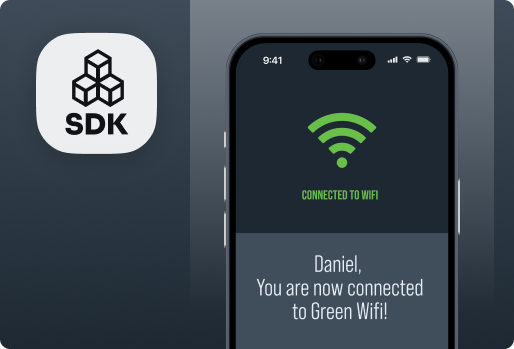
Simplify guest Wi-Fi access for mobile app users. Automatically onboard mobile app users on to Wi-Fi. Engage with them contextually and integrate the data with CRM/loyalty systems.
Business Impact
Reduce IT workload, improve Wi-Fi adoption, and deliver secure, reliable connectivity for patients and visitors. Lower dependency on costly DAS systems by enabling a carrier-grade experience over existing Wi-Fi infrastructure, eliminating the need for additional hardware and reducing both capital and operational expenses.
Leveraging your Cisco Wireless Access points, Spaces can understand the location of visitors in a building and can automatically trigger notifications and workflows based on entry, exit, or dwell times, in a building, floor or zone.
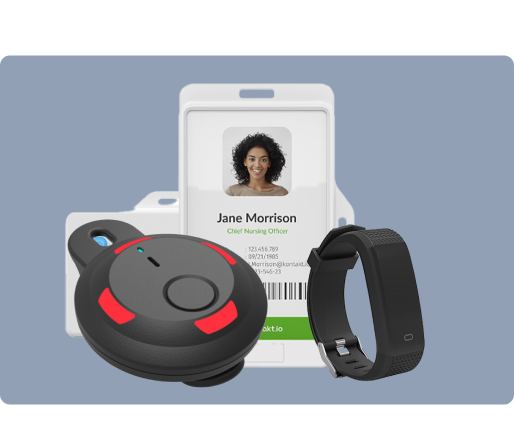
Third Party Sensors from cisco spaces ioT device marketplace